
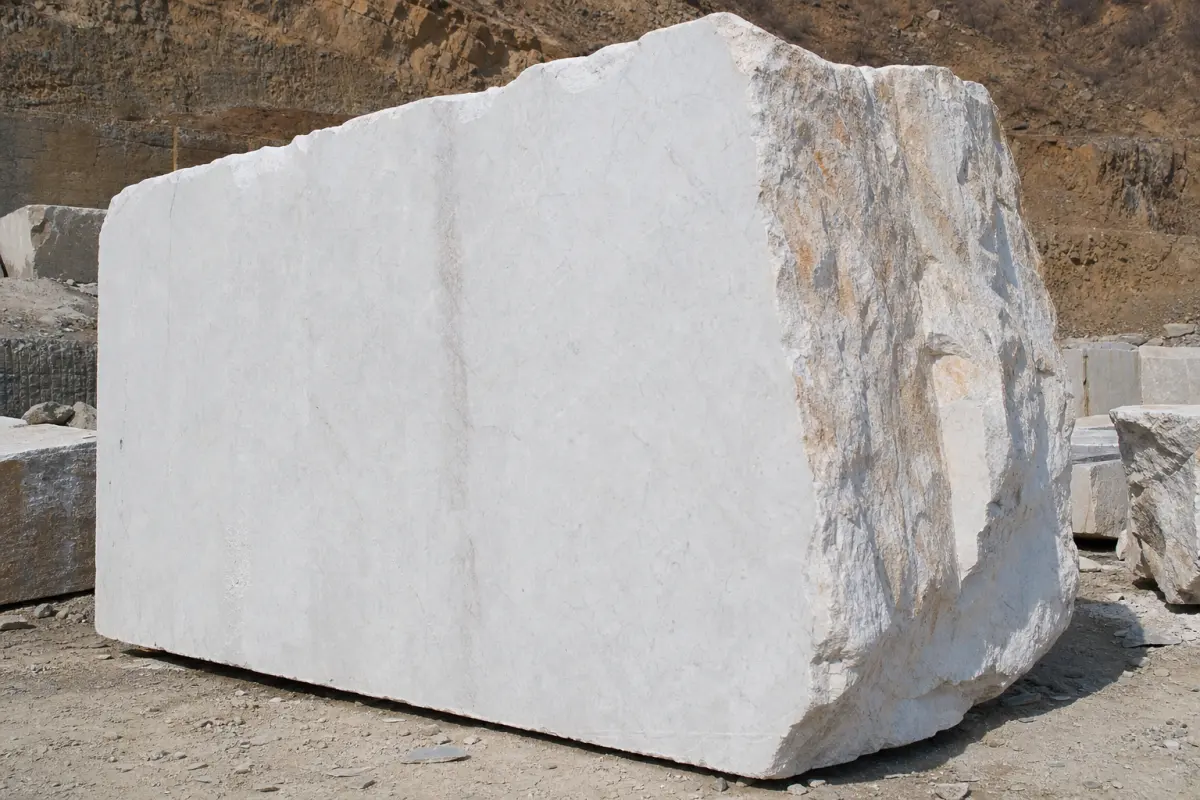
Most Buner leases still break marble with explosives. That is cheap on the day and expensive for the deposit, the valley, and anyone living downhill. This research guide maps the old blasting method, what science actually says about earthquakes, the environmental record, and the drills, diamond wires, splitters, and silent cracking agents that turn a mountain into a saleable raw block.
Stand on a Buner quarry bench at Bampokha, Nanser, or Chagharzai and you can usually hear the method before you see the stone. A hole is drilled. A charge is stemmed. The face jumps. Dust hangs in the Chamla air. What falls is not a square block that a gangsaw wants. It is a pile of irregular boulders, many of them already cracked through the heart, mixed with powder that will never become a slab. That is still the default way much of Khyber Pakhtunkhwa takes marble out of the mountain — in Buner, in parts of Mohmand and Bajaur, in Swat and Mardan leases that never bought a wire saw.
This is a research guide, not a sales brochure. It explains how dimension-stone extraction is supposed to work, why blasting remains dominant in Buner, what it does to water, forest, and the rock that is still in the hill, and what tools actually replace explosives. It also takes the earthquake question seriously. Local operators often say blasting “disturbs the earth plates” and can cause quakes. The science is more precise than that slogan, and more useful: blasting is a form of technical seismicity, it can damage slopes and houses, mass removal can change stress on nearby faults, and northern Pakistan is already a high-seismic plate-boundary region. None of that is a reason to keep using dynamite on ornamental marble.
If you are buying stone, the extraction method is a product spec. A wire-sawn Bampokha raw marble block and a blasted boulder with the same colour name are not the same SKU. If you run a lease, the tool list below is the conversion path from “cheap bang” to square blocks that factories and exporters will pay for. Pair this guide with our earlier brief on Buner’s factory taxes and industry scale — the fiscal story and the quarry-method story are now the same decade.
What “cutting a mountain” actually means
Marble in Buner is not an aggregate quarry. Aggregate wants broken rock. Dimension stone wants a rectangular prism — typically 2 to 3 metres long, 1.4 to 2 metres high, 1.2 to 1.8 metres thick, twelve to twenty-two tons — that a factory can clamp on a gangsaw. The international name for that object is a raw block. Browse the class on StoneVaults under raw blocks. Everything downstream — Bampokha No.1 slabs, Super White, 60×60 tiles — is only as sound as the block that left the face.
A competent quarry therefore does three geometric cuts, not one explosion. First a vertical cut isolates a bench from the mountain. Second a horizontal (or slightly inclined) cut frees the bench from the floor. Third a back cut, often by chain saw or a second wire, separates the bench from the uncut mass. The freed volume is then subdivided into transportable blocks with wire, hydraulic splitters, or a quiet expansive mortar. Water cools the diamond. A crane or loader lifts a cube, not a rubble pile. That is how Carrara, Afyon, and well-run Indian and Chinese marble quarries work. It is also what PASDEC has been trying to demonstrate in Pakistan since 2006.
Blasting skips the geometry. Explosive gas pressure finds every joint and bedding plane and opens them. The “block” that rolls down the talus is already full of micro-cracks. Those cracks become resin-filled spider webs on the slab, or they become waste. Pakistan Stone Development Company has said for years that average quarry loss under blasting is on the order of 75 percent, against a mechanised ceiling nearer 45 percent. Some industry and legal papers on Buner put total production waste — quarry plus factory slurry — around 70 percent. A 2026 industry yield guide for diamond-wire quarrying cites blasting waste in the 50–80 percent band versus single-digit kerf loss on a clean wire cut. The exact percentage varies by deposit. The direction of the error does not.
How blasting is still done on Buner faces
Conventional marble mining in KP, as described in the 2019 Buner sustainability analysis by Khan and colleagues in the International Journal of Economic and Environmental Geology, produces irregular blocks rather than regular ones. Field notes from mine visits in the district describe high explosives, jackhammers, and rented machinery that is often poorly maintained. The sequence is familiar:
- A pneumatic or hand-held rock drill (commonly a YT28-class air-leg jackhammer) punches a pattern of holes into the face.
- Cartridges of dynamite, ANFO, or locally sourced gelatin explosives are loaded. Stemming is often soil or stone dust, not designed stemming.
- The shot is fired with safety fuse or electric detonators. Delay timing, if it exists at all, is crude.
- A loader or labour gang sorts what looks “blocky” from what is powder. The rest becomes talus, fill, or a slurry problem downstream.
Khan’s AHP study is blunt: conventional mining is the least sustainable option on economic, technical, social, environmental, and safety criteria. It produces maximum waste, cracks, irregular shapes, high working faces, back-break, rock falls, and accidents. The same paper still found blasting or cheap conventional methods in use at important commercial faces, including Sunny Grey at Bampokha and jet black at Nanser, even where wire cutting would score better. That is the 2019 snapshot. Walk those roads in 2026 and you will still hear shots. Mechanisation is visible on some Bampokha and white faces, as later field notes by industry engineers have observed. It is not the district default.
Why not? Capital. A 55 kW quarry wire-saw package with rails, flywheels, diamond wire, and a compressor is a serious cheque. Explosives are a weekly cost that a small lease can finance from the last truck. PASDEC’s Risalpur and Gaddani machinery pools exist precisely because owners lack that cheque: they rent wire saws and related kit on subsidised terms to “discourage blasting techniques.” Daily Times reporting on PASDEC’s national drive says 135 mines have moved toward mechanised square-block cutting, with waste claimed down from about 85 percent to about 45 percent. Buner still has hundreds of factories and far fewer truly mechanised quarries. The mill can polish. The mountain is still being broken.
What blasting does to nature in Buner
The environmental file is not anecdotal. A legal study of Buner’s marble industry against the Khyber Pakhtunkhwa Environmental Protection Act, 2014 (and PEPA 1997) reported 247 factories operating without the environmental procedures the statutes require, with wastewater discharged to nearby rivers, plus air, noise, and land pollution. Marble processing is water-hungry. Slurry — calcium-carbonate fines in water — turns clear streams milky. That is a factory problem as much as a quarry problem, but blasting feeds it: more waste rock means more crushing, more sawing of cracked blocks, more fines.
At landscape scale, a 2024 paper in the Journal of Mountain Area Research mapped Buner land use from 1988 to 2018. Mining area expanded by 5.69 km² and destroyed 4.88 km² of forest cover in that window. Forest loss overall in the district was far larger (on the order of 97 km²) because agriculture and built-up land also ate woodland — but the authors treat unregulated blasting-based mining as a powerful driver of mountain landscape change, and they call for inspection, EIA, and mitigation. New mine roads and vehicles in the second period accelerated access to faces that used to be too remote to wreck.
PASDEC’s Marble City Risalpur note adds a point mill owners under-price: the shock of blasting has a collateral effect on surrounding unexplored reserves. Stone that is still in the hill is already cracked by the last shot next door. You are not only wasting this year’s block. You are degrading next year’s bench. That is why a wire-sawn face can keep producing commercial Badal grey or northern black from the same massif, while a blasted face turns a colour brand into kanda and powder.
Air and noise are the daily nuisances. Flyrock is the acute safety one. High faces after blast-and-muck cycles are the chronic geotechnical one. Khan’s paper lists rock falls and accidents among conventional mining’s outputs. None of these require an earthquake to ruin a village below the lease.
Blasting, “earth plates,” and earthquakes — what the research actually says
This is the claim that needs care. Buner sits in a seismically active mountain belt. The Indian and Eurasian plates converge at about 37–42 millimetres per year. The Main Boundary Thrust, Main Mantle Thrust, and Hindu Kush deep sources already load Khyber Pakhtunkhwa. The 2005 Kashmir earthquake and the 2015 Hindu Kush earthquake damaged the province without any marble shot being required. A 2020 natural-hazards study of Peshawar’s seismic maps makes that plate-boundary setting explicit. Buner is not a quiet craton. Calling the district “earthquake country” is correct. Blaming ordinary quarry dynamite for moving tectonic plates is not.
Three separate phenomena get mixed in local talk. They should be kept apart.
1. Technical seismicity: the blast is a small seismic event
Every commercial shot sends elastic waves into the ground. Seismographs record them. The U.S. Geological Survey states plainly that mining and construction blasts can produce waves large enough for a national seismic network, and that those events have a different fingerprint from tectonic earthquakes — typically a shorter surface-wave “echo,” a location within a mile or two of an active quarry, and often an area not otherwise known for earthquakes. USGS maps mark reviewed mine blasts with a diamond, not as tectonic quakes. A 2021 Applied Sciences paper on quarry blasting in Slovakia treats this as “technical seismicity”: short-lived vibration, not an earthquake, but still capable of annoying residents and cracking buildings. The practical metric is peak particle velocity (PPV), not magnitude on the moment-magnitude scale. In that Slovak case, bringing PPV under about 2 millimetres per second satisfied nearby inhabitants; building-protection limits were discussed in the 3 mm/s range depending on frequency and foundation. Uncontrolled Buner shots are rarely instrumented at all.
So: blasting does shake the ground. People feel it. Houses crack. That is real. It is not the same physical object as a tectonic earthquake on the Main Boundary Thrust.
2. Slope failure, back-break, and local collapse
In steep marble, the dangerous coupling is blast vibration plus high faces plus jointed rock. Engineering papers on blast-induced slope stability treat blasting as a seismic load that is short-lived but close, and they warn that excavated slopes get worse as pits deepen. Khan’s Buner analysis already flags high working faces, back-break, and rock falls under conventional methods. A shot does not need to “cause an earthquake” to kill someone on the bench or send a wedge into a nala. For a Himalayan foothill lease, this is the first-order seismic risk of explosives.
3. Induced or triggered earthquakes, and mass removal
Human activity can, in specific settings, advance a real earthquake on a fault that is already close to failure. That is not plate-shifting. It is a small stress change on a critically loaded plane. Two research results matter for a honest Buner briefing.
First, the 2019 Mw 4.9 Le Teil earthquake in southern France. A 2020 paper in Communications Earth & Environment found that almost two centuries of mass removal at a nearby cement quarry likely provided the Coulomb stress change that hastened the event by more than 18,000 years. The nucleation sat where surface unloading was greatest. The authors warn that further mass removal could activate deeper parts of the same fault. That is quarry geometry changing crustal stress — a slow, cumulative effect, not a single dynamite stick “moving a plate.”
Second, a 2020 Journal of Geophysical Research: Solid Earth study of mine-blasting in British Columbia argued that blasting at Mount Milligan was associated with a linear trend of seismic events, with dynamic triggering plausible to about 20 km and possible blasting-related events inferred farther along a previously unmapped, near-critical fault. Mining-induced seismicity is well documented in deep hard-rock mines; far-field triggering by quarry shots is rarer and remains an active research topic. It is not a licence to say “Buner blasting will cause the next Hindu Kush earthquake.” It is a licence to say: do not add explosive stress and large-scale unloading in a fold-and-thrust belt without geotechnical design.
The responsible summary for operators and buyers: Buner blasting does not shove the Indian plate. It does generate felt vibration, it does crack remaining marble and nearby masonry, it does destablise high faces, and in the worst documented international cases quarry unloading or blasting has been linked to advancing failure on nearby faults. In a district that already sits on a colliding-plate margin, replacing explosives with diamond wire is both a quality decision and a precaution.
The conventional toolkit still on Buner benches
Before listing replacements, name what is already there. A typical non-mechanised Buner operation is not tool-less. It is under-tooled.
- YT28 / YT29 pneumatic air-leg rock drills — handheld or air-leg jackhammers, often 34–42 mm holes, for blast patterns. Cheap, loud, slow on deep benches.
- Portable air compressors (diesel, 7–12 bar) — the real bottleneck. When the compressor dies, the face dies.
- Explosives and detonators — dynamite, ANFO, safety fuse. Quality has long been a complaint of the Malakand Marble Association; poor explosive means more shattering, not a cleaner break.
- Wheel loaders and small excavators — to muck irregular stone. Many are rented. Field notes from KP mine visits describe poor maintenance and operators pushed for tonnage over machine life.
- Trucks — rigid dumps or farm-modified Hino/Mazda trucks hauling shapeless blocks down jeep tracks that become torrents in monsoon.
- Wedges, feathers, and sledgehammers — the pre-modern splitter. Still useful for dressing a block after a cut; useless as the primary method on a 15-metre face.
- Shovels, crowbars, and labour gangs — still the sorting system for blast piles.
PASDEC field experience and academic visits both note that even when a wire saw is present, cracked blocks can appear if the deposit was already damaged by neighbouring blasts or if the saw is run without geological planning. Tools do not replace a face design.
Modern methods: how to take a square block out of a Buner mountain
The conversion is a kit, not a single machine. International reviews of dimension-stone extraction (including a 2023 open-access review in Mining) now treat diamond wire, chain saws, hydraulic splitters, and chemically induced fracturing as the mainstream, and thermal shock or unplanned blasting as historical or special-case. For Buner marble — calcite-rich, often well bedded, sometimes dolomitic — the practical stack is drill, wire, optional chain saw, then splitter or expansive mortar.
Step 1 — See the rock before you cut it
Down-the-hole (DTH) drills and core barrels take samples from several stations on the hill. Cores show colour continuity, healed fractures, clay seams, and whether the mass is worth a wire. Skipping this step is why some PASDEC demonstration faces still produced cracked blocks: the machine was modern, the geology was not mapped. A DTH rig for marble typically drills 76–90 mm holes, with 50-metre class depth on catalogue machines, using a down-hole hammer and button bit, air or water flush. Horizontal core-boring machines (electric, water-cooled) drill the long holes that the diamond wire will later pass through — often tens of metres if the bench is wide.
Product names you will see on quotes: DTH hammers and bits (76/90 mm), drill rods 73×1500 mm class, horizontal core drills with 50 m class rating, and a separate compressor sized for the hammer (this is not the small jackhammer compressor).
Step 2 — Diamond wire saw: the primary cut
This is the tool that ends blasting on a marble face. A steel wire set with sintered or electroplated diamond beads (commonly 10.5, 11, 11.5 or 12 mm bead diameter) is looped through two or more holes and driven around a flywheel. Linear speed is typically up to about 40 m/s on quarry machines. Water binds dust and cools the beads. The kerf is a few millimetres. Vibration is low. Noise is a motor and a hiss, not a shock wave. The same machine, with guide wheels, cuts vertical, horizontal, or inclined planes — the three faces of a bench.
Catalogue classes used worldwide, including by Chinese OEMs common in Pakistan’s import mix, run roughly:
- 37 kW class (DWS-37 type) — block squaring and trimming, lighter quarry cuts. Main unit around 2.5 tons. Flywheel invert ±180°. Max cut spacing on the order of 1.75 m.
- 55 kW class (DWS-55 type) — standard big-block mining. Rails in 2 m sections, five sections typical. Main unit around 2.8 tons. Cut spacing around 1.95 m.
- 75 kW class (DWS-75 type) — large, hard, or deep benches. Main unit around 3.6 tons. Cut spacing around 2.1 m. Permanent-magnet motor variants (DWS-37M/55M/75M) reduce heat and raise cutting capacity.
Consumables are not optional: diamond wire by the metre, beads, rubber springs, water pumps, and spare flywheel liners. A mine that buys the saw and starves the wire budget will go back to explosives within a season. PASDEC’s northern machinery pool at Risalpur is the rental door for KPK leases that cannot buy a 55 kW unit outright. Application requires the mining lease, CNIC, a PASDEC survey, two months’ security plus one month advance, and PASDEC’s operator on site.
Step 3 — Quarry chain saw / arm cutter for the back face
Research on combining diamond wire with chain-saw machines (SECA and AHP papers in the dimension-stone literature) often finds a hybrid: wire for long vertical and horizontal cuts, chain saw for the back cut where a wire loop is awkward. A quarry chain saw is an arm with a diamond chain that plunges into the bench like a giant chainsaw. It needs a stable rail or crawler, three-phase power or a large generator, and water. Capital is high; on a high-value white face such as Bampokha No.1 it can pay. Khan’s 2019 recommendation already pointed Bampokha No.1 and Chagharzai white toward mechanised rope cutting. A chain saw is the complement, not a contradiction.
Step 4 — Hydraulic rock splitters for silent secondary breaking
Once a bench is isolated, you still have to make truck-sized blocks. A hydraulic splitter is a steel cylinder whose insert goes into a drilled hole (about 41–43 mm on a Darda C10S-class stone cylinder). A hydraulic wedge drives two feathers apart. Splitting force on quarry-specific models is in the 220–260 ton class (up to around 4000 kN on larger concrete/rock cylinders). The split forms in seconds, along a planned plane, without the hairline cracks blasting puts into the remaining stone. Manufacturers market these cylinders specifically so “burnt” (stuck) blocks can be freed without destroying them. A complete unit is three parts: splitter, hydraulic power pack, and hose set. Several cylinders in a row give an even split on a long block.
This is the right tool for dressing a raw Bampokha block to a factory rectangle without another explosive. It is also how you salvage a bench that was already lightly damaged.
Step 5 — Expansive mortar (soundless cracking agent)
Where capital for splitters is short, or the face is too shattered for a clean hydraulic plane, soundless cracking agent (SCA / HSCA / “expansive mortar”) is the chemical middle path. Calcium-oxide-based powder is mixed with cold water and poured into 30–45 mm holes (32–45 mm is the usual quarry band; 35–45 mm for harder stone). Hole spacing is typically 20–50 cm depending on hardness; burden to the free face must be smaller than spacing or the charge can blow out. Expansion pressure on common grades is on the order of 30–60 MPa at 8–24 hours; high-range products advertise 100 MPa and above. Cracks usually appear in 3–24 hours. There is no blast wave, no flyrock, and little noise. There is a wait. Temperature-matched grades (Type I hot, Type II mild, Type III cold) matter in Buner’s summer-to-winter swing; wrong grade plus hot holes is a blow-out hazard.
Khan’s AHP result recommended semi-mechanised methods — controlled blasting or expansion material — specifically for Sunny Grey at Bampokha and jet black at Nanser, and full rope cutting for Bampokha No.1 and Chagharzai white. That is a deposit-by-deposit choice, not a slogan. Black, massive, abrasive stone may want more splitter force and closer SCA holes. Soft white with open joints may wire-cut almost like limestone.
Step 6 — Lift, square, and ship
A mechanised quarry still needs a gantry or derrick crane, slings rated for 20–30 tons, and a loader that can place a cube without chipping corners. Block-squaring wire saws (smaller 37 kW class) trim the six faces so a mill in Swari or Risalpur can clamp the stone without wasting the first gangsaw run. This is the difference between an export block and a domestic “kanda” rate. Provincial royalty already prices that difference: super white at a higher rupee-per-ton tier than ordinary marble or kanda, as our tax research brief laid out.
Factory tools: what happens after the mountain
A square block only becomes a slab if the mill matches the quarry. Buner’s 350–500 factories are the second half of the tool story. The classic line:
- Gangsaw / multi-blade block cutter — a frame of steel blades with diamond segments, or a multi-wire saw replacing blades, slicing a block into 2 cm or 3 cm slabs. Multi-wire is the yield upgrade. A blasted, out-of-square block wastes the first and last slabs and jams the clamp.
- Bridge saw / CNC cutter — for tiles, cut-to-size, and book-matched panels. Needed if you sell calibrated 60×60 tiles rather than only jumbo slabs.
- Calibrating machine — diamond heads that bring thickness to tolerance. Export packages die on thickness scatter.
- Resin line — epoxy fills pits and hairline cracks. Resin is a profit centre when the quarry already cracked the stone with explosives; it is a quality step when the quarry did not.
- Automatic polisher (typically 12–20 heads) — grit sequence to a mirror on Super White or honey onyx (onyx wants gentler pressures and often a different pad set).
- Edge polishers, chamfering, and packing — foam, A-frames, and wooden crates for Karachi or Port Qasim.
Water recycling and filter presses belong on this list as environmental equipment, not extras. The KPEPA 2014 file on Buner factories is largely a slurry-and-river file. A mill that installs a settling tank and a press is doing more for the Barandu than a mill that only buys a shinier polisher.
A practical kit list for a Buner lease converting off explosives
Budgets vary. This is the shopping list in the order that actually changes the face.
- Geological walkover plus 4–8 core holes (DTH or contractor coring) before buying steel.
- Diesel compressor sized for DTH, not only for jackhammers.
- One horizontal boring machine for wire-pass holes.
- One 55 kW quarry diamond wire saw, 200–400 m of diamond wire, water pump, and rails.
- Two to four hydraulic splitters with a power pack — or, if cash is tighter, 2–4 tons of temperature-correct expansive mortar and a drill pattern discipline.
- Lifting: crane or forklift rated above your heaviest planned block, plus slings and corner protectors.
- A simple PPV seismograph if any village sits within a few hundred metres — even after you stop blasting, neighbours will want proof.
- PPE, lock-out on the flywheel, and a written no-explosives rule on the lease. Mixed methods on the same bench recreate the crack problem the wire was bought to avoid.
Then rent before you buy. PASDEC’s Risalpur pool is built for northern clusters. The paperwork is tedious (lease copy, survey, security deposit, PASDEC operator). It is still cheaper than a wrecked white bench. For FATA-side marble, PASDEC lists a separate CIPK / FATA machinery window. Gaddani covers the south.
What buyers should look for on a Buner block
Extraction method shows up in the stone. Ask for quarry photos of the face, not only the polished slab. A wire-cut face is planar, with parallel saw marks and little talus. A blast face is scalloped, dusty, and stacked with shapeless boulders. On the block itself, look for:
- Six reasonably square faces, not three and a rubble back.
- Absence of radiating shatter from a blast hole.
- Colour continuity that matches the named variety — Bampokha white is not interchangeable with cloudy Super White or with pink fancy.
- A net weight and a yield estimate, not only a truck count.
StoneVaults listings that start at the quarry — such as Zeex Naturals’ Buner profile and the marketplace filters for origin and form — exist so a buyer can RFQ a block or a slab with that trail attached. Use the stone inspector when you are comparing photographs. Use a factory visit when the volume is a container. Do not accept “Buner white” as a method-neutral grade. The mountain either was cut or it was broken.
Why the old method survives — and how policy can end it
Blasting survives because it is familiar, because explosives logistics in the old PATA belt are a known (if ugly) channel, because leases are fragmented, and because mills will still buy cracked blocks at a discount to keep gangsaws turning. It also survives because electricity on the factory side is unreliable, so owners hoard cash rather than capitalise the quarry. Our tax brief covers the new 12 percent federal sales tax on industrial supplies; that levy makes wasted stone even more expensive. Every cracked cubic metre now carries royalty, diesel, labour, and tax. The economic case for wire saws is stronger in 2026 than it was when Khan’s AHP paper appeared in 2019.
Policy already points the same way. PASDEC’s mandate is to cut quarry wastage from the mid-70s toward 45 percent and to demonstrate mechanised mining. Marble City Risalpur was justified in writing as an answer to “the age old practice of blasting.” Buner’s own long-promised Marble City is the northern twin of that idea. KPEPA 2014 already requires environmental approval that most roadside mills ignore. None of those instruments work if a lease can still fire a naked shot at dusk with no PPV limit, no face design, and no inspection.
A workable local rule set is not mysterious: ban unplanned blasting on dimension-stone leases; allow only designed, instrumented, low-PPV shots where wire geometry is impossible; require diamond-wire or splitter methods on white and other high-value faces; tie royalty discounts or machinery-pool priority to square-block recovery rates; and enforce slurry control on the factory side so the Barandu is not the district’s settling tank. That is regulation in the service of the rock, not against the mill owner.
Frequently asked questions
Does marble blasting in Buner cause earthquakes?
It causes ground vibration that people feel and that seismographs can record. USGS treats those records as quarry blasts, a different fingerprint from tectonic earthquakes. Buner already sits on the Indian–Eurasian collision zone; Hindu Kush and thrust-fault earthquakes happen with or without mines. Rare international cases show quarry mass removal or blasting can advance failure on a nearby, critically stressed fault. That is a reason to stop reckless explosives in a seismic mountain belt. It is not evidence that a Buner shot moves tectonic plates or “causes” the next regional earthquake.
What is the single best replacement for dynamite on a marble face?
A quarry diamond wire saw (55 kW class for most Buner benches), fed by properly drilled wire-pass holes, with hydraulic splitters or expansive mortar for secondary breaking. Chain saws help on the back cut. Core drilling should come first so you do not wire-cut a ruined massif.
Can small leases afford this?
Not always as a cash purchase. PASDEC machinery pools at Risalpur (north) and Gaddani (south) rent the kit with a PASDEC operator. Splitters and soundless cracking agent are the low-capex on-ramp. Continuing to blast high-value white marble is the expensive option once waste, royalty, and tax are counted.
Which Buner deposits should be mechanised first?
Khan et al. (2019) ranked mechanised rope cutting as most sustainable at Bampokha No.1 and Chagharzai white, and semi-mechanised expansion methods as a better fit than naked blasting at Sunny Grey and Nanser jet black. Start where the block price can pay for the wire: export whites and consistent greys, then blacks.
Do factory machines matter if the quarry still blasts?
They cannot put the crystals back together. Resin and polish hide some cracks. They do not restore yield. Buy or supply natural stone from faces that were cut, then put the mill capex on multi-wire gangsaws, calibration, and water recycling.
Sources and further reading
- Khan et al., “Sustainability Analysis of Marble Sector in Buner,” Int. J. Econ. Environ. Geol. 10(3), 2019 — AHP ranking of conventional vs semi-mechanised vs rope cutting at Bampokha, Nanser, Chagharzai.
- Ullah et al., “Buner Marble Industry within Environmental Legal Perspective,” Research Journal of Social Sciences & Economics Review — KPEPA 2014 / PEPA 1997, factory count, slurry and river pollution, ~70% process waste.
- Khan & Rahman, “Unregulated Marble Mining… Khyber Pakhtunkhwa,” Journal of Mountain Area Research (2024) — 1988–2018 land-use change, mining expansion, forest loss.
- PASDEC, About us and Machinery pools — wastage targets 75%→45%, Risalpur/Gaddani rental rules, blasting discouragement.
- PASDEC, Marble City Risalpur — blasting as primary cause of low yield and collateral damage to unmined reserves.
- Daily Times, “135 mines in Pakistan adopt mechanised mining techniques” — PASDEC square-block drive, 85%→45% waste claim.
- USGS, “Does the Latest Earthquakes map show non-earthquake seismic events?” — quarry-blast fingerprints vs tectonic quakes.
- De Novellis et al., “Coincident locations… 2019 Le Teil earthquake,” Communications Earth & Environment (2020) — quarry mass removal and Coulomb stress.
- Kao et al., “Reactivation of an Intraplate Fault by Mine-Blasting Events,” JGR Solid Earth (2020) — blasting-associated seismicity in British Columbia.
- Kondela et al., “Research of the Technical Seismicity Due to Blasting Works in Quarries,” Applied Sciences 11(5) (2021) — PPV, buildings, residents.
- Waseem et al., “Seismic hazard maps of Peshawar District,” Nat. Hazards Earth Syst. Sci. 20, 1639–1661 (2020) — Indian–Eurasian convergence, Hindu Kush and thrust sources for KP.
- Careddu & Siotto and subsequent dimension-stone reviews; Elmo et al., “A Review of Dimension Stone Extraction Methods,” Mining 3(3) (2023) — wire saws, splitters, chemical fracturing vs historical blasting.
- OEM catalogues (HUADA DWS-37/55/75, Darda C10S, SCA/HSCA datasheets) — power classes, hole diameters, expansion pressures cited as typical product ranges, not endorsements.
- StoneVaults: marketplace, raw blocks, Buner tax research.
This guide describes extraction practice and published research as of September 2026. It is not a blasting licence, a seismic-hazard assessment, or a product endorsement. Face design, explosive use, and slope stability require a qualified mining engineer and the relevant KP minerals and environmental authorities.