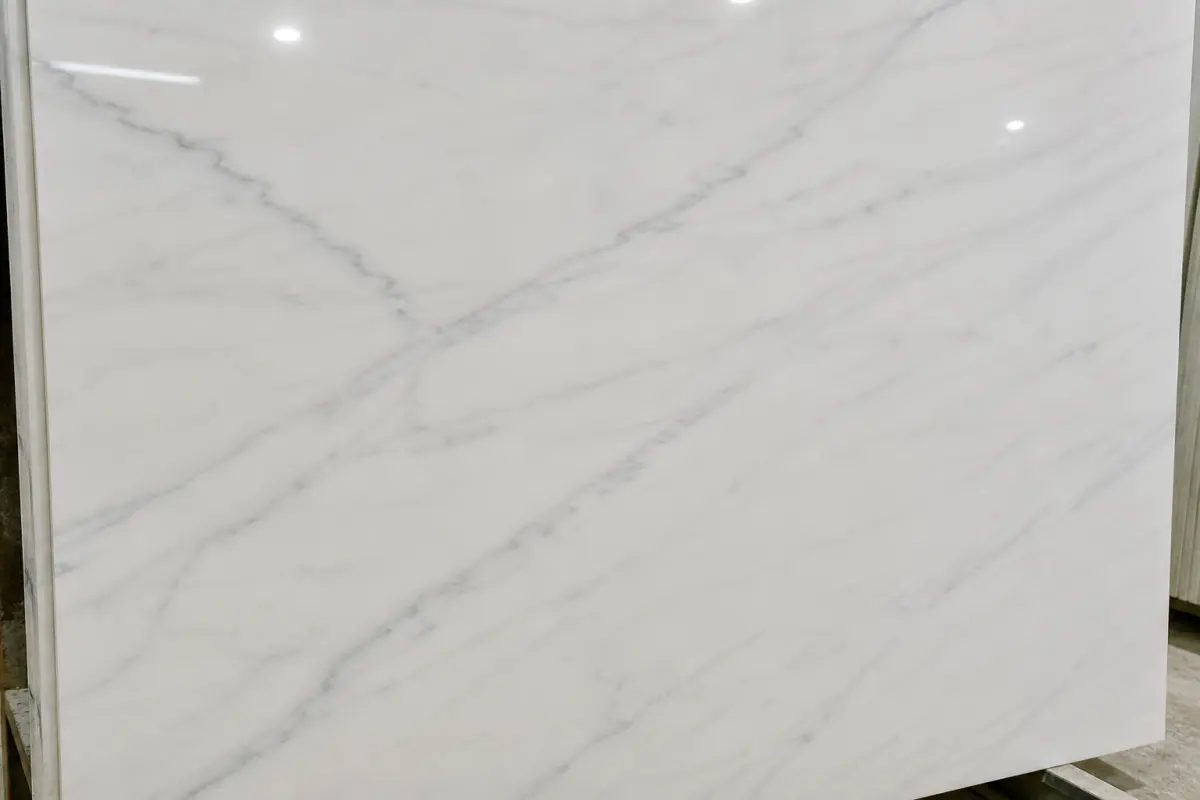
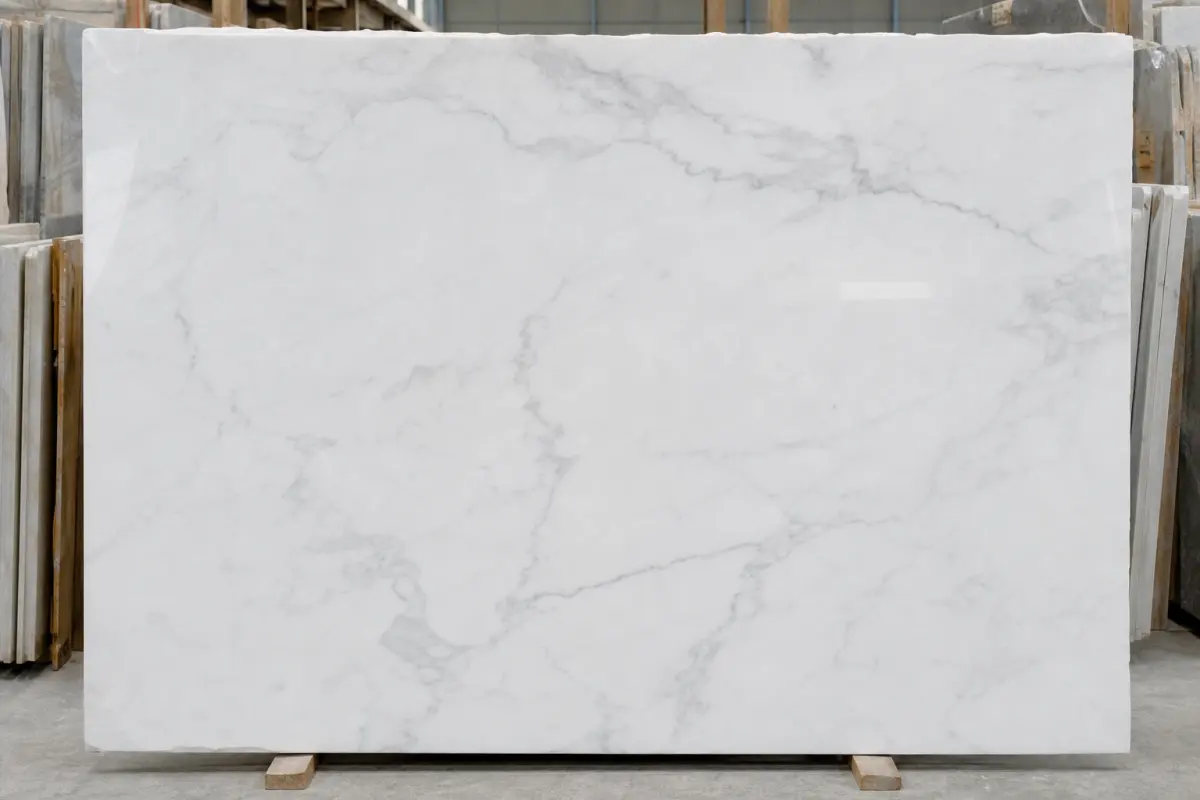
Buner still holds Pakistan’s densest marble-factory cluster. The constraint is not the hill. It is PESCO’s bill, the surcharge stack on every unit, and outages that stop a gangsaw mid-cut. This research brief maps tariffs, taxes, feeder-level load shedding, and what buyers should ask mills in 2026.
Buner district sits on one of Pakistan’s densest natural-stone belts. The Khyber Pakhtunkhwa Board of Investment and Trade still publishes the cluster numbers that have defined the map for more than a decade: of about 700 marble factories in Malakand Division, roughly 500 sit in Buner, credited with about 51 percent of Pakistan’s marble production. Geological papers put resources in the Buner–Mardan belt on the order of 1.4 billion tons. The names that leave those hills — Bampokha whites, Super White, Badal grey, Nanser blacks — are the same lots you can still open as calibrated slabs and raw blocks on StoneVaults.
The constraint in 2026 is not a shortage of stone. It is electricity: what Peshawar Electric Supply Company (PESCO) charges for a unit, what NEPRA and FBR pile on top of that unit, and how many hours a mill in Swari, Elai, Torwarsak, or Chamla actually receives. Pair this brief with our earlier notes on factory sales tax after the PATA holiday and on blasting versus diamond wire saws. A 12 percent invoice on a load-shed gangsaw is not the same cost as the same invoice on a 24-hour line.
What is actually at stake in Buner’s marble industry
Hold the factory count with a grain of salt, the same way we treated the 51 percent production share in the tax brief. KPBOIT and Express Tribune reporting from the Malakand Marble Association used ~500 Buner units and ~700 across the division. Academic papers reused the 51 percent line. In August 2023, Sajjad Khan of the Marble Mines Industry Development Association told Profit by Pakistan Today that more than 6,000 marble factories across Khyber Pakhtunkhwa were on the brink after IMF-linked tariff hikes. That 6,000 figure is an association talking point, not a census. It likely folds in small cutting sheds, tile shops, and units outside Malakand. The operational truth is still large: Buner is Pakistan’s densest marble-processing cluster, and Pakistan Today reporting from 2020 already put about 80 Buner units as closed on power tariffs and weak demand.
Employment claims are advocacy figures too. Association leaders speak of hundreds of thousands of workers across Buner, Swat, Mardan, Nowshera, Swabi, Peshawar, Abbottabad, and Mansehra — quarry labour, gangsaw operators, polishers, truckers, and traders. There is no published labour-force survey that pins 200,000 as a hard headcount. The political weight is real either way: when mills go dark in Buner, the district feels it.
Export dollars are thinner than the mountain. UN Comtrade / WITS data for HS 251512 (marble and travertine merely cut into a square) show about USD 15.6 million of Pakistani exports in 2023 and USD 13.3 million in 2024, mostly low-unit-value blocks to China, then Italy, the UAE, and Bangladesh. Crude marble (HS 251511) added about USD 1.1 million in 2024. China took roughly 72–73 percent of that square-cut value. IndexBox’s 2024 marble-and-travertine series puts the average Pakistani export price at about USD 181 per ton, down 3.9 percent on the year. Industry decks that still say “USD 50 million plus” are mixing HS lines, granite, and older talking points. Customs-cleared marble is a thin slice of what finished Super White slabs and 60×60 tiles could earn if mills could run.
PESCO electricity tariff: what marble factories actually pay
Marble processing is among the most power-hungry jobs in the district. Gangsaws, diamond wire saws, grinders, and polishing lines run three-phase motors for hours. A mid-size Buner mill can draw tens of thousands to low hundreds of thousands of kilowatt-hours a month when it has shifts. The bill is not the NEPRA slab printed in a newspaper. It is the slab, plus fuel cost adjustment, plus quarterly adjustment, plus a debt surcharge, plus 18 percent GST, plus advance income tax under Section 235.
The headline industrial tariff has come off its 2024 peak. The Power Division said in 2026 that industrial tariffs including taxes had fallen from about Rs 62.99 per unit in March 2024 to about Rs 46.31 per unit in December 2025, with the national average down from Rs 53.04 to Rs 42.27. That is relief from a crisis high, not a cheap input. A mill that was paying near Rs 63 all-in is still paying the mid-forties — and still losing hours to feeder-level load management.
Do not mix domestic slabs with factory bills. Household rates (first 100 units, 301–700, above 700) are a different schedule. Marble factories sit on industrial categories B-1 through B-4 depending on sanctioned load and voltage. Time-of-use peak and off-peak rates, plus monthly fixed charges on kW / MDI, matter as much as the variable rupee. Check the live PESCO / NEPRA schedule of tariff before pricing a contract; the numbers below are research context, not a substitute for the mill’s last bill.
The incremental Rs 22.98 package — and why many Buner mills miss it
On 9 December 2025 NEPRA approved the federal Incremental Consumption Package for industrial and private agricultural consumers of XW-DISCOs and K-Electric. Incremental units above the December 2023–November 2024 reference period are billed at Rs 22.98 per kWh for three years. Positive fuel cost adjustments still apply on those incremental units. Quarterly tariff adjustments, the debt service surcharge, and negative FCAs do not. Industry groups at the hearing called the package complicated and asked for a flat ~USD 0.09 tariff instead. The catch for Buner is structural: a factory that already cut shifts in 2024 has a low baseline, but a factory that was already dark has little “incremental” consumption to claim. Greenfield rules exist; a mill that simply wants last year’s hours back at a lower rate is not who the package was written for.
The tax stack inside a PESCO marble-factory bill
The surcharge stack is where the “unit rate” becomes fiction. As of 2026 the important layers are:
- General sales tax (18%). Standard GST on electricity remains 18 percent. It is applied on energy charges (and, in practice, on a wide slice of the bill), not as a rounding error.
- Fuel cost / fuel price adjustment (FCA or FPA). A monthly NEPRA notification that tracks generation fuel. It can add or subtract rupees per unit. Mills remember months when the FCA nearly doubled the base. KPK’s political argument is older than the current tariff: the province’s cheap hydel should not pay thermal fuel volatility.
- Debt service surcharge (DSS), Rs 3.23 per unit. This is not the old Rs 0.43 “FC surcharge” talking point still circulating in industry notes. Dawn and The Nation reported in late 2025 that consumers will keep paying Rs 3.23/kWh for up to six years to service circular-debt financing of about Rs 1.225 trillion. On 100,000 units that line alone is Rs 323,000 a month.
- Quarterly tariff adjustment (QTA). A periodic true-up. It moves. Treat any single-quarter rupee as dated.
- Advance income tax, Section 235. For industrial consumers whose gross bill exceeds Rs 20,000, FBR’s tax-year 2026 schedule is Rs 1,950 plus 5 percent of the amount above Rs 20,000 (commercial is 12 percent above that threshold). On a Rs 3 million bill the industrial withholding is on the order of Rs 150,000 that month — adjustable against annual income tax, but cash leaving the mill every billing cycle.
- Electricity duty. A small provincial percentage on variable charges, plus minor meter and TV-fee lines that add insult more than arithmetic.
An illustrative mid-size mill using 100,000 units at a Rs 30 energy rate is not a live PESCO invoice, but it shows the shape. Energy Rs 3.0 million; DSS at Rs 3.23 another Rs 0.32 million; GST at 18 percent on energy another Rs 0.54 million; FCA and QTA can add hundreds of thousands more; Section 235 sits on the gross. Effective rupees per unit in the mid-forties to high-forties is consistent with the Power Division’s own “including taxes” industrial figure. For a Buner owner already paying 12 percent federal sales tax on industrial supplies and provincial royalty on every ton, power is often the largest monthly cash drain — commonly described by operators as 40 to 60 percent of conversion cost when the mill can run at all.
The Peshawar High Court FPA case — and the Supreme Court sequel
Industry briefs still say the Peshawar High Court “banned” fuel adjustment in KPK and that PESCO simply ignored the order. The docket is less clean. In December 2013 a PHC bench (Chief Justice Dost Muhammad Khan and Justice Nisar Hussain Khan), on petitions from about 72–80 industrial units, declared collection of fuel adjustment charges from KPK consumers illegal and ordered refunds. The February 2014 detailed judgment called a uniform fuel levy discriminatory where KPK supplied cheap hydel and had no thermal plant on its own soil. In April 2014 the Supreme Court suspended that PHC ruling and directed PESCO to collect the disputed amount (reporting at the time put the stock near Rs 17 billion) after finding the high court had proceeded without hearing the Attorney General. Fuel-cost adjustments have continued on KPK bills. Sajjad Khan was still citing the 2014 PHC line in 2023. The legal history matters: the grievance is live; the PHC order is not the last word.
Load shedding in KPK: PESCO losses, feeders, and marble saws
PESCO has been among the worst-performing DISCOs on transmission and distribution losses. NEPRA’s FY 2022–23 performance evaluation put PESCO’s actual T&D losses at 37.13 percent against an allowed 20.16 percent. Ministry reporting the same year used 37.40 percent, with a financial impact around Rs 169 billion. A March 2026 NEPRA order on circular-debt data recorded PESCO losses rising further to 38.14 percent in FY 2023–24, with the associated financial loss up to about Rs 97 billion from Rs 78 billion. High-loss feeders are then used to justify long daily outages. Paying industrial consumers on those feeders are punished for theft and under-recovery they did not cause.
The feeder map is the part most national articles skip. The Nation, citing official documents in June 2024, reported 1,305 PESCO feeders: 981 domestic, 190 industrial, 134 independent. On paper, the 190 industrial and 134 independent feeders had zero load shedding. Domestic feeders were sliced by loss band: 2 hours below 20 percent losses, 6–7 hours in the 20–40 percent bands, 12 hours at 40–60 percent, 16 hours at 60–80 percent, and 20 hours above 80 percent. Of 981 domestic feeders, 443 faced 12 to 20 hours. That is why two marble factories a few kilometres apart can tell opposite stories. A mill on a dedicated industrial feeder may keep lights. A mill sharing a high-loss rural or mixed feeder in Buner’s valleys can lose 12–20 hours and still receive a full-looking bill when power returns.
Summer 2024 made the politics national. PESCO acknowledged brutal unscheduled cuts; the KPK chief minister threatened to take over PESCO over 20–22 hour outages; a temporary “relief” capped 75 high-loss feeders at 12 hours. Consumer guides still listed PESCO among the worst DISCOs into 2026, with urban Peshawar often quoted at 8–10 hours and rural feeders at 14–16 hours, with DI Khan pockets reported near 20 hours in June 2025. NEPRA has separately told DISCOs that AT&C (loss-and-recovery) based load shedding is not how Rule 4(f) of the Performance Standards (Distribution) Rules, 2005, is supposed to work: industrial consumers sit near the bottom of the shed list, after rural households and before schools, hospitals, and defence. Practice on PESCO’s high-loss map has not matched that priority. A revised April 2026 load-management line — publish feeder schedules 24 hours ahead — improves predictability. It does not restore a gangsaw’s missing shift.
Marble machines hate that pattern. A gangsaw or wire saw stopped mid-cut risks the blade and the block. Voltage sag and the surge when supply returns destroy drives. Workers sent home lose the day. Export containers slip. Diesel gensets, when the mill can afford diesel, often cost a multiple of grid power. Solar helps lighting and offices; it does not yet replace a 100 kW-class saw hall unless the owner has invested in a serious hybrid plant. That is why so many Buner quotes on the marketplace stay “price on request”: the conversion cost is a function of last month’s hours, not a stable sheet.
The KPK hydropower paradox
Khyber Pakhtunkhwa generates the country’s cheapest bulk hydel and still buys darkness. Association figures used in 2023 put provincial hydro capacity around 6,000 MW against demand around 2,700 MW, with only about 1,500 MW said to reach industry. Later 2025–26 writing is more precise and more awkward: Voice of KP cited ~4,500 MW contributed to the national grid against local demand under 3,000 MW; The News described 2025 load-shedding while the province received 2,500–2,800 MW against peak demand near 3,300 MW even as the national system showed surplus. In September 2026 the KPK government publicly revived plans for its own transmission and grid, arguing the province supplies more than 70 percent of national hydropower but has no network to keep that power at home. Article 157 and the 18th Amendment are the constitutional language industry uses. The physics is simpler: energy is injected into a federal grid, allocated by DISCO performance and politics, and returned to Buner as a PESCO feeder schedule.
Closures, diesel, and the export discount
When power is both expensive and intermittent, mills do three things. They cut shifts. They sell more raw blocks and fewer polished slabs. Or they close. The 2023 association warning sat on top of the 2020 Buner closures already in the record. Bajaur’s smaller cluster — 29 factories in one Lok Sujag dispatch — saw monthly bills jump on the order of 76 percent in a single shock, from a few hundred thousand rupees toward Rs 865,000, while residential areas in the merged district got two or three hours. Swat’s marble association has repeatedly threatened shutdowns over outages. Construction demand in Pakistan has been weak in the same years: cement and steel expensive, public works lumpy. Factory owners cannot pass a Rs 46 all-in unit into a domestic slab price when builders are not buying.
That is how Pakistan stays a block exporter. Chinese processors take HS 251512 cargo, finish it, and keep the margin. Every extra rupee of PESCO cost and every lost gangsaw-hour pushes Buner further down that chain. A wire-sawn block is already a better SKU than a blasted boulder — see the quarry-tools guide — but a wire-sawn block that never reaches a 24-hour polish line is still a low-value export.
What government has done, and what Buner still needs
The useful moves are real. Industrial tariffs including taxes are off the March 2024 peak. The Rs 22.98 incremental package exists for three years from December 2025. A 2023 KP industrial relief package was announced in parallel with Punjab. NEPRA wants feeder schedules published a day ahead. Plans for a Buner Marble City / estate — hundreds of acres, shared power, mineral desks — have been in ADP language since at least FY2021, with 2024–25 directions to finish land for KP-EZDMC. In September 2026 Islamabad-facing coverage of a provincial grid was the first structural attempt in years to match hydel generation with local industrial load.
The gaps are also real. There is still no marble-sector-specific, multi-year capped industrial tariff. DSS at Rs 3.23/kWh is now a larger line than the old “FC surcharge” talking points. FPA/FCA still lands on KPK bills after the Supreme Court sequel to the PHC case. PESCO losses are worse, not better, into FY 2023–24. Marble City is a direction, not a park with a dedicated busbar. Official zero-shedding on “industrial feeders” does not help a mill that was never migrated onto one.
A practical list, not a manifesto:
- Migrate Buner marble clusters onto dedicated industrial or independent feeders, and enforce NEPRA’s shed-priority so industry is not treated as a high-loss domestic tail.
- Publish and keep the 24-hour feeder schedule; unscheduled cuts destroy blades.
- Price a transparent industrial bill: energy, FCA, QTA, DSS, GST, Section 235 — one sheet mills can model.
- Let load-shed mills access incremental or relief energy without a 2024 baseline that punishes plants already forced down.
- Put Marble City’s power first — on-site solar-plus-hydel or a firm industrial feeder — not last.
- Tie any extra subsidy to processed exports (slabs, tiles, cut-to-size), not raw-block volume.
What buyers and suppliers should do now
If you are sourcing Buner marble in 2026, ask the mill which feeder it sits on and how many productive hours it ran last month. Ask whether the lot was gangsaw-cut on grid, on diesel, or from stock. Expect longer lead times and more “price on request.” A Honey Onyx feature slab and a commodity white from the same district can have completely different power stories. Browse live Pakistani listings on the StoneVaults marketplace, or start from Zeex Naturals if you want a Buner mill already publishing specs. If you run a factory and want the outage and bill pattern on the record, use the contact form.
Frequently asked questions
Why are marble factories in Buner closing if KPK produces surplus hydropower?
Because generation in the province is not the same as delivery to a mill. Power is pooled nationally. PESCO then sheds high-loss feeders. Many Buner units are not on the 190 industrial feeders that official 2024 data listed as zero-shed.
What is the PESCO electricity tariff for a marble factory in 2026?
There is no single number. Industrial B-category energy charges, peak/off-peak TOU, fixed kW charges, FCA, QTA, Rs 3.23 DSS, 18 percent GST, and Section 235 withholding all stack. Power Division’s own all-in industrial figure for December 2025 was about Rs 46 per unit, down from about Rs 63 in March 2024. Read the mill’s bill, not a domestic slab chart.
Does the Rs 22.98 industrial package apply to Buner marble factories?
It can, on incremental units above the December 2023–November 2024 baseline, for three years from NEPRA’s 9 December 2025 approval. Mills that already reduced output, or that cannot grow above that baseline, get little. Positive FCA still applies on the incremental block.
Is Fuel Price Adjustment illegal in Khyber Pakhtunkhwa?
The Peshawar High Court said collection was illegal in 2013–14. The Supreme Court suspended that judgment in 2014 and ordered collection of the disputed stock. FCA/FPA still appears on bills. Treat “PHC banned FPA” as incomplete.
How many marble factories are there in Buner?
KPBOIT’s long-standing figure is about 500 in Buner and 700 in Malakand Division, with Buner credited for ~51 percent of national marble production. Treat those as cluster indicators. The 6,000-factory “KP-wide brink of closure” line from 2023 is an association claim, not a factory census.
Sources and further reading
- KPBOIT, Buner District — factory count and 51 percent production claim.
- NEPRA Performance Evaluation Report, DISCOs, FY 2022–23 — PESCO T&D losses 37.13 percent vs 20.16 percent allowed.
- NEPRA order (March 2026) citing CPPA-G circular-debt data — PESCO losses 38.14 percent in FY 2023–24.
- The Nation (22 June 2024) — 1,305 PESCO feeders; industrial/independent listed at zero shedding; domestic high-loss feeders 12–20 hours.
- Profit by Pakistan Today (7 August 2023) — Sajjad Khan, 6,000-factory warning, 6,000 MW vs 2,700 MW talking points, PHC FPA grievance.
- Express Tribune (December 2013–April 2014) — PHC FPA judgment and Supreme Court stay / collection order.
- NEPRA decision (9 December 2025) and Profit / Dawn coverage — Rs 22.98/kWh incremental industrial-agriculture package.
- Dawn (2026) and The Nation (15 December 2025) — debt service surcharge Rs 3.23/kWh.
- Power Division (2026 tariff briefing) — industrial all-in tariff Rs 62.99 (March 2024) to Rs 46.31 (December 2025).
- WITS / UN Comtrade — Pakistan HS 251512 and 251511, 2023–2024; IndexBox 2024 average export price ~USD 181/ton, China ~72 percent of value.
- Lok Sujag — Bajaur marble mills, bill shock and 12-hour industrial supply vs 2–3 hour residential.
- ProPakistani (2 September 2026) — KPK plan for its own transmission and grid.
- Pakistan Today / earlier StoneVaults tax brief — ~80 Buner units reported closed in 2020 on power and demand.
Figures were current as of September 2026. Confirm the live PESCO schedule of tariff, NEPRA FCA/QTA notifications, and the mill’s feeder class before pricing a slab or a power-relief claim. This is industry research, not legal, tax, or tariff advice.