
For years Buner’s marble factories sat inside the former PATA tax holiday. That era is over for goods sales tax. This research brief maps the cluster’s size, the new levies on factories and suppliers, and the odd parallel still visible on Buner’s roads: NCP cars that have not been pulled into ordinary vehicle tax.
Buner’s marble belt is no longer the tax-exempt processing cluster it was after the 2018 merger. For years, industrial units in the former Provincially Administered Tribal Areas — including hundreds of marble factories around Swari, Elai, Torwarsak, Chamla, and Chagharzai — sat inside a federal holiday on income tax and sales tax. That holiday on goods sales tax is what ended. From July 2025, qualifying factories and the suppliers who invoice them began paying a reduced federal sales tax. As of fiscal year 2026–27, the rate on those industrial imports and supplies is 12 percent, climbing toward the standard 18 percent by July 2029.
This research brief is not a tax opinion. It pulls together district production figures, Finance Act language, provincial royalty rates, and trade data to answer three questions: how large Buner’s stone economy really is, what tax now sits on marble factories and suppliers, and why the same district can tax mills while non-custom-paid (NCP) cars still run on a different track.
Why Buner sits at the centre of Pakistan’s stone map
Buner is a mountain district of about 1,865 square kilometres in Malakand Division, Khyber Pakhtunkhwa, with roughly 897,000 residents in the 2017 census. Agriculture is rain-fed. The cash economy is stone. The Khyber Pakhtunkhwa Board of Investment and Trade (KPBOIT) still publishes the figure that has defined the cluster for more than a decade: of about 700 marble factories in Malakand Division, roughly 500 sit in Buner, credited with about 51 percent of Pakistan’s marble production. Express Tribune reporting from the Malakand Marble Association used the same factory count. Later academic papers reused the 51 percent share. Treat Buner as a processing hub, not only a quarry belt: blocks from Bampokha, Nanser, and Chagharzai feed local gangsaws and mills elsewhere in the division.
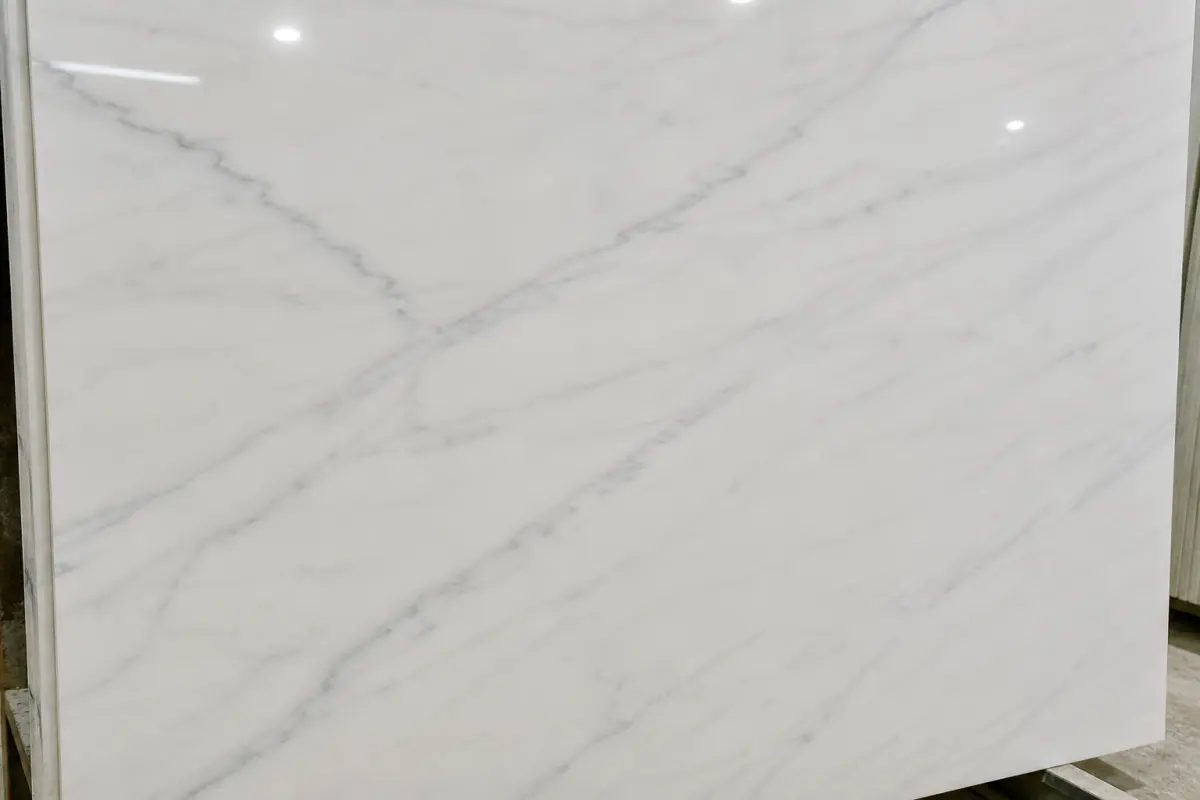
Other minerals are present — barite, dolomite, granite, quartz — but marble is the mainstay. KPBOIT’s 2014–15 Bureau of Statistics snapshot listed 758,108 tons of marble from Buner against 9,076 tons of dolomite, 1,240 tons of barite, and 580 tons of granite. Commercial names that travel with those tons include Bampokha (Sunny White and Sunny Grey families), Buner White and Carrara-type whites, Nanser jet black, and Chagharzai white. TDAP’s marble-and-granite study placed Buner in Pakistan’s white, grey, and black belts, with greens, browns, and yellows also reported from the wider province.
The extraction story is harder than the colour chart. A 2019 sustainability analysis (Khan et al., International Journal of Economic and Environmental Geology) treated Buner as KP’s most productive marble-mining cluster, with geological resources on the order of 1.4 billion tons in the Buner–Mardan belt. Conventional blasting still dominates many leases. It is cheap on the day and expensive over the life of a deposit: irregular blocks, cracked faces, and waste rates that would not survive a Carrara or Afyon cost sheet. Where grades justify it, wire saws are visible. That split matters for tax: a mill already losing half a block to blasting cannot absorb a new sales-tax layer as easily as a calibrated slab line.
How large is the industry, in dollars?
Calling Buner a multi-million-dollar industry is conservative at the mill gate and still fair on the export ledger — if the two numbers are not mixed. If the district moved about 758,000 tons of marble in 2014–15, even a cautious mill-gate value of USD 50 to 100 per ton implies USD 38 million to USD 76 million of stone in a single statistical year, before fabrication or export premiums. Association leaders have claimed the wider Malakand marble chain supports hundreds of thousands of workers. Those are advocacy figures, not a labour-force survey, but they explain why a factory tax is a political event in Buner, not a footnote in an FBR circular.
Customs data are smaller. UN Comtrade / WITS figures for Pakistan’s HS 251512 (marble and travertine merely cut into a square) show about USD 15.6 million of exports in 2023 and USD 13.3 million in 2024, mostly low-unit-value blocks to China, then Italy, the UAE, and Bangladesh. Crude marble (HS 251511) added about USD 1.1 million in 2024. There is also a statistical tension: if Buner truly produced 51 percent of national marble, an Economic Survey-era national output near 8 million tons would imply around 4 million tons from one district, an order of magnitude above the 2014–15 BoS line. Informal production, a share that refers to processed dimension stone, outdated factory counts, or a recycled talking point could all be at work. Hold both facts: Buner is Pakistan’s densest marble-factory cluster, and the dollars that clear customs are still a thin slice of what finished slabs could earn. About 80 Buner units were already reported closed in 2020 on power tariffs and weak demand. Growth means value-added stone, not more blasting.
The long tax-free years
Buner was PATA. After the Constitution (Twenty-fifth Amendment) Act, 2018 merged the tribal areas into Khyber Pakhtunkhwa, Islamabad granted industrial units in former FATA and PATA a time-bound exemption from income tax and sales tax. The original window ran to 30 June 2023, then was extended through 30 June 2024 and again through 30 June 2025. Coverage explicitly included Buner, Swat, Dir, and Dargai on the PATA side, and Bara, Mohmand Marble City, Bajaur, and the Waziristans on the FATA side. Marble factories sat on the same list as ghee, steel, plastics, and power looms.
For owners, “no tax in Buner” was the business model: machinery and inputs into the tribal-area concession, factory supplies out without federal sales tax. Settled-area mills in Mardan, Peshawar, and Punjab argued for years that the concession leaked into their markets. FBR later used that complaint as the reason to phase the exemption out rather than cut it overnight. Two other clocks never stopped. Provincial mineral royalty was always due. Electricity bills were always due. The holiday was a federal-goods holiday, not a cost holiday.
What changed: tax on marble factories and suppliers
Finance Act 2025 is the break. FBR’s 2025–26 salient features and Circular No. 02 of 2025–26 describe the old exemption under S. No. 151 of Table-1 of the Sixth Schedule to the Sales Tax Act, 1990, replaced by a phased rate under S. No. 89 of the Eighth Schedule:
- July 2025 to June 2026: 10 percent
- July 2026 to June 2027: 12 percent
- July 2027 to June 2028: 14 percent
- July 2028 to June 2029: 16 percent
- July 2029 and onwards: 18 percent
Those rates apply to imports and supplies by industrial units in erstwhile FATA/PATA, and to plant, machinery, equipment, and industrial inputs for those units. As of September 2026 the live rate is 12 percent — not 18 percent yet, and not zero. A Buner gangsaw that priced slabs on a tax-free sheet now needs a tax invoice. A supplier who buys that lot is in the same documentary world. Cash trucks become a compliance risk, not a local custom. After Peshawar High Court litigation over port clearance, FBR issued CGO-08/2025 putting concessionary imports back onto tracked, bonded movement through Azakhel Dry Port. Gangsaws, polishers, and abrasives no longer slip through a quiet Karachi side door.
Do not collapse “the holiday ended” into one sentence. Income tax is on a slower clock: the same salient features proposed extending the FATA/PATA income-tax and withholding exemption through tax year 2026. Provincial sales tax on services is a third layer. In September 2026 the Khyber Pakhtunkhwa Revenue Authority notified a conditional exemption for qualifying industrial undertakings in former FATA/PATA, from 1 August 2026 through 30 June 2028. Marble blocks and slabs are goods under FBR. Freight and some processing contracts may sit under KPRA. Factories that budget for “one tax” will mis-count.
Royalty, power, and the costs that were never zero
The Khyber Pakhtunkhwa Mines and Minerals (Second Amendment) Act, 2024, in force from 1 July 2024, restated royalty: super white marble Rs 500 per ton, ordinary marble Rs 100, marble “kanda” Rs 60, black granite Rs 600, other granite Rs 400. Those dues are owed whether or not FBR collects sales tax on factory invoices. In 2020 the Buner Mining Association told Pakistan Today that units were already paying on the order of Rs 230 million in royalty, then about Rs 60 per ton plus Rs 5 excise. March 2025 provincial finance reporting claimed mineral royalties across KP had surged about 200 percent, with Rs 5.4 billion collected from mines and minerals. Buner is not that whole number, but it is a large piece of the marble line. Power is the other old levy that never used the word tax: 2020 coverage described mills running about eight hours a day. A 12 percent invoice on a load-shed mill is not the same burden as the same invoice on a 24-hour estate.
The split on the ground: taxed marble, still-untaxed NCP cars
Walk out of a Buner factory gate and the fiscal story splits. Inside the mill, federal sales tax is now a cost line. On the road, NCP cars remain a defining feature of Malakand Division: imported vehicles on which full federal customs duty was not paid. KP Excise reported compiling more than 110,000 such vehicles across Malakand and the merged districts in 2024. In 2025 it ran a profiling drive — CNIC, purchase proof, a short office visit, a temporary plate — and Excise Minister Khaleeq-ur-Rehman stated publicly that the exercise would not itself impose tax. Customs, he said, is federal. A marble factory is now inside a published FBR schedule. An NCP car outside the same gate is still, in provincial language, being documented rather than assessed as an ordinary registered vehicle. Profiling is not motor-vehicle tax, and it is not customs. Anyone buying such a car must still verify legal status. The research point is sequencing: industrial tax in Buner moved first. Vehicle taxation did not move in lockstep.
Local listings make the parallel visible. KP Wheel is a Khyber Pakhtunkhwa marketplace for used and NCP cars, with Buner ads sitting next to Malakand, Swat, and Dir stock. The site’s own explainer is blunt: NCP vehicles are imported without full customs duty, they are common in KPK, and buyers must check legality independently. Marble is being formalised through invoices and dry-port tracking. The vehicle fleet that grew up under the same old PATA exception has not been dropped into the same tax net on the same timetable. That is a description of the dual economy, not an argument that NCP cars should stay outside customs, or that marble factories should be exempt again.
Marble City, and what buyers should do now
Every serious Buner plan says the same thing: move mills into a serviced estate, cut blasting, train operators, sell calibrated slabs. KPBOIT asked for a zone with power, mineral-department desks, and a freight node. The provincial ADP reported Rs 800 million toward a marble estate as early as FY2021. Owners have asked for a marble city since at least 2011. In September 2024 the district administration told the Special Assistant to the KP Chief Minister on Industries that land acquisition would finish in two months. In January 2025 the same office was still directing KP-EZDMC and the deputy commissioner to clear hurdles within a month. Treat Marble City as a committed direction, not a finished park. If the 12 percent — and the 14, 16, and 18 percent that follow — is recycled into power and wire saws, growth is plausible. If it is only a revenue patch, more units will switch off. The rock in the ground outlasts any tax schedule. The factories do not.
Buyers who still treat “Buner” as a synonym for tax-free stone are pricing last year’s market. Ask for a sales-tax invoice. Ask which cluster the lot came from — Bampokha, Nanser, Chagharzai, Elai — because royalty already prices super white differently from ordinary marble. Expect some mills to quote price on request while they rebuild sheets around 12 percent and the July 2027 step-up. Suppliers selling into settled cities should assume undocumented lots get harder to move: Azakhel tracking exists because settled industry complained about leakage. Browse current slabs and blocks on the StoneVaults marketplace. Buner is still Pakistan’s densest marble cluster, still a multi-million-dollar domestic industry, and now a taxed one.
Frequently asked questions
Is marble in Buner still tax-free?
No, not for federal sales tax on industrial imports and supplies. The FATA/PATA exemption ended after 30 June 2025. The live Eighth Schedule rate in FY 2026–27 is 12 percent, rising to 18 percent from July 2029. Provincial royalty on marble was already charged and was restated from 1 July 2024.
Are suppliers in the net as well as factories?
Yes in the practical sense: supplies by industrial units in the erstwhile tribal areas sit inside the new sales-tax schedule, and traders who buy those lots need matching invoices. How any one firm is registered is a matter for FBR and a tax advisor, not a sourcing article.
Why do people still say there is no tax on cars in Buner?
Because NCP vehicles were profiled without, according to KP excise officials, a new provincial vehicle tax in that drive. Customs duty remains federal and, on a true NCP car, unpaid. The two systems did not enter the net together. Used and NCP listings on kpwheel.com still show Buner and neighbouring-district stock. That is a picture of the market, not legal clearance to buy one.
Sources and further reading
- KPBOIT, Buner District — factory count, 51 percent production claim, 2014–15 mineral table.
- FBR Budget 2025–26 Salient Features and Circular No. 02 of 2025–26 — Sixth Schedule S. No. 151 phase-out; Eighth Schedule S. No. 89 rate ladder.
- FBR CGO-08/2025 — tracked concessionary imports via Azakhel Dry Port.
- Khyber Pakhtunkhwa Mines and Minerals (Second Amendment) Act, 2024 — marble royalty tiers.
- The Nation / APP (2024–25) — Buner Marble City land and KP-EZDMC directions.
- WITS / UN Comtrade — Pakistan HS 251512 and 251511, 2023–2024.
- Express Tribune (2011); Pakistan Today Profit (2020, 2025) — factories, closures, royalties.
- Khan et al., “Sustainability Analysis of Marble Sector in Buner” (2019).
- KP Wheel — KPK used and NCP car listings, including Buner.
Figures were current as of September 2026. Confirm the live Eighth Schedule entry, royalty notification, and vehicle rules with the relevant authority before pricing a contract or a car.